← Learning Library

CLAY, GLAZES & PATTERNS

The kiln
has the final say.

The patterns that define Jian Zhan are not simply painted onto the bowl. They emerge from the interaction of iron-rich clay, mineral glaze, atmosphere, temperature and cooling.

Look Closer ↓
FPO IMAGEHero glaze macroExtreme close-up of crystalline Jian Zhan surface with dark negative space

THE FOUNDATION

Before the pattern,
there is clay.

At first glance, Jian Zhan is often defined by its glaze: shimmering oil spots, fine Hare's Fur streaks, deep black surfaces or dramatic crystalline effects.

But those surfaces begin with something much more fundamental. Traditional Jian Zhan developed in the Jianyang region of Fujian, where local clays contain relatively high levels of iron.

The clay, glaze and firing respond together. The maker creates the conditions for a pattern to develop, but the final result is created inside the kiln.

FPO IMAGEClay body + foot detailSide or underside macro showing exposed iron-rich clay, trimmed foot and glaze termination

IRON-RICH CLAY

It starts with the body.

The iron-rich clay body contributes to the characteristic dark color and substantial feel associated with Jian ware. Depending on the clay composition and firing, the exposed body may appear dark brown, reddish-brown, gray-black or nearly black.

For collectors, the clay is especially visible at the foot, where part of the vessel is traditionally left unglazed.

THE GLAZE

More than
color.

Jian Zhan glazes are typically iron-rich crystalline glazes.

Inside the kiln, the glaze melts and flows while iron and other minerals undergo chemical and physical changes. Under the right conditions, crystals and phase separations develop within or on the glaze as the piece fires and cools.

Those reactions create the surfaces for which Jian Zhan is famous.

01Materials

Iron-rich clay and mineral glaze establish the possibilities.

→
02Heat

The glaze melts and begins to move across the vessel.

→
03Atmosphere

Oxygen conditions influence how iron behaves in the kiln.

→
04Cooling

Crystals and patterns continue developing as the glaze cools.

CONTROLLED UNPREDICTABILITY

The maker controls
the conditions.
Not the outcome.

A maker can influence glaze formulation, application, firing temperature, kiln atmosphere, placement and cooling. But reproducing an identical surface from one firing to another can be extraordinarily difficult.

Two bowls made by the same artist, from the same clay and glaze and fired together, can emerge with noticeably different patterns.

That variability is not a flaw. It is part of Jian Zhan's appeal.
FPO IMAGEInside the firingKiln interior / glowing bowls / heat and atmosphere visual

A VISUAL VOCABULARY

Understanding Jian Zhan patterns.

Collectors use pattern names to describe what they see in the glaze. These categories are useful, but nature does not always produce perfectly defined boundaries.

A single piece may show characteristics of more than one pattern, and contemporary makers continually experiment with variations on traditional effects.

Think of these names as a visual vocabulary — not an inflexible classification system.
Oil Spot Jian Zhan glaze

CRYSTALLINE PATTERN

Oil Spot

油滴

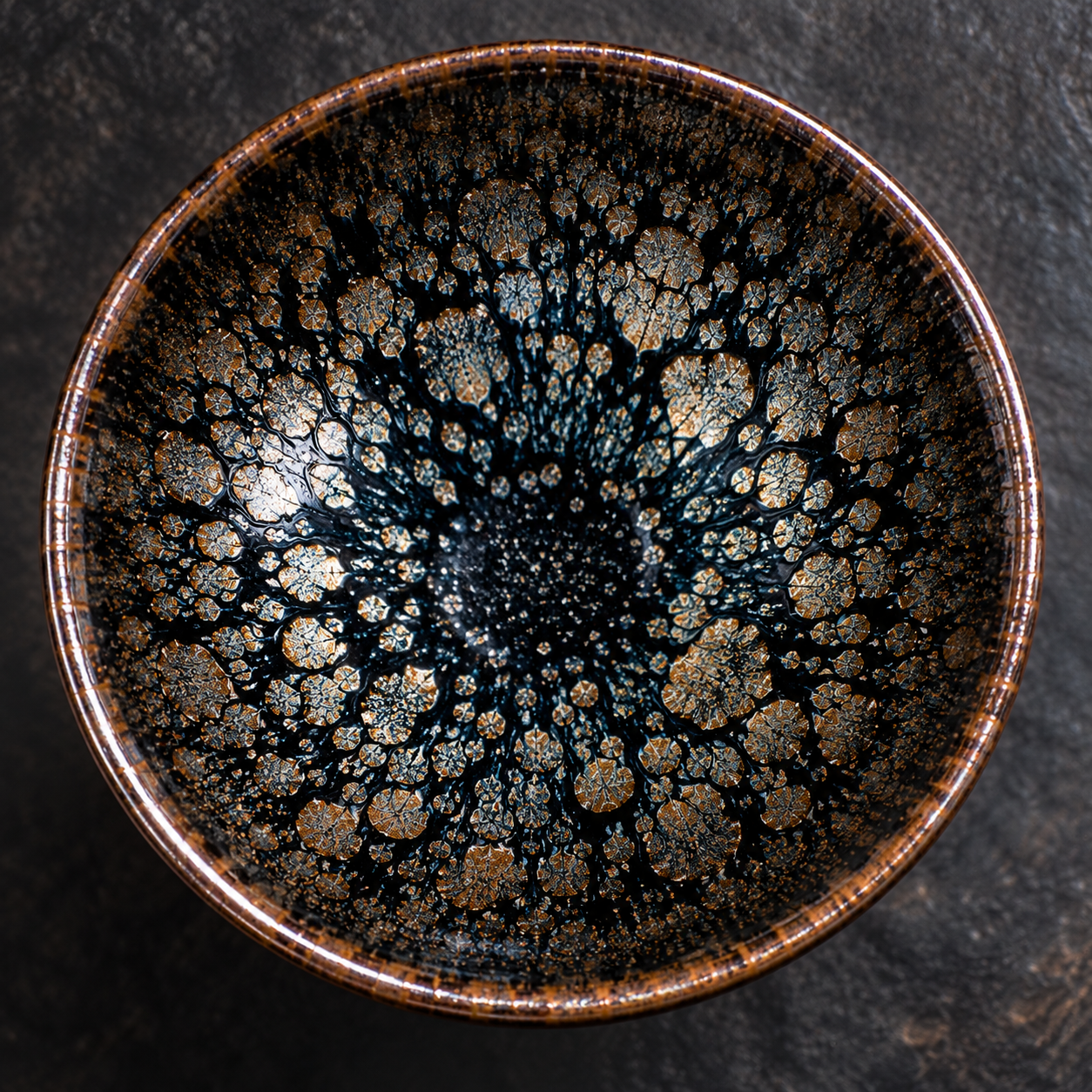
Rounded or irregular spots emerge against a darker glaze, often producing silver, blue, bronze, gold or iridescent reflections depending on the piece and the light.

The effect develops through the behavior of iron-rich material during firing and cooling. The spots are not individually painted onto the surface.

WHAT TO LOOK FOR

Look at the definition of the spots, their distribution across the vessel, variation in size and the way they change under different lighting.
Hare’s Fur Jian Zhan glaze

CLASSIC JIAN WARE

Hare’s Fur

兔毫

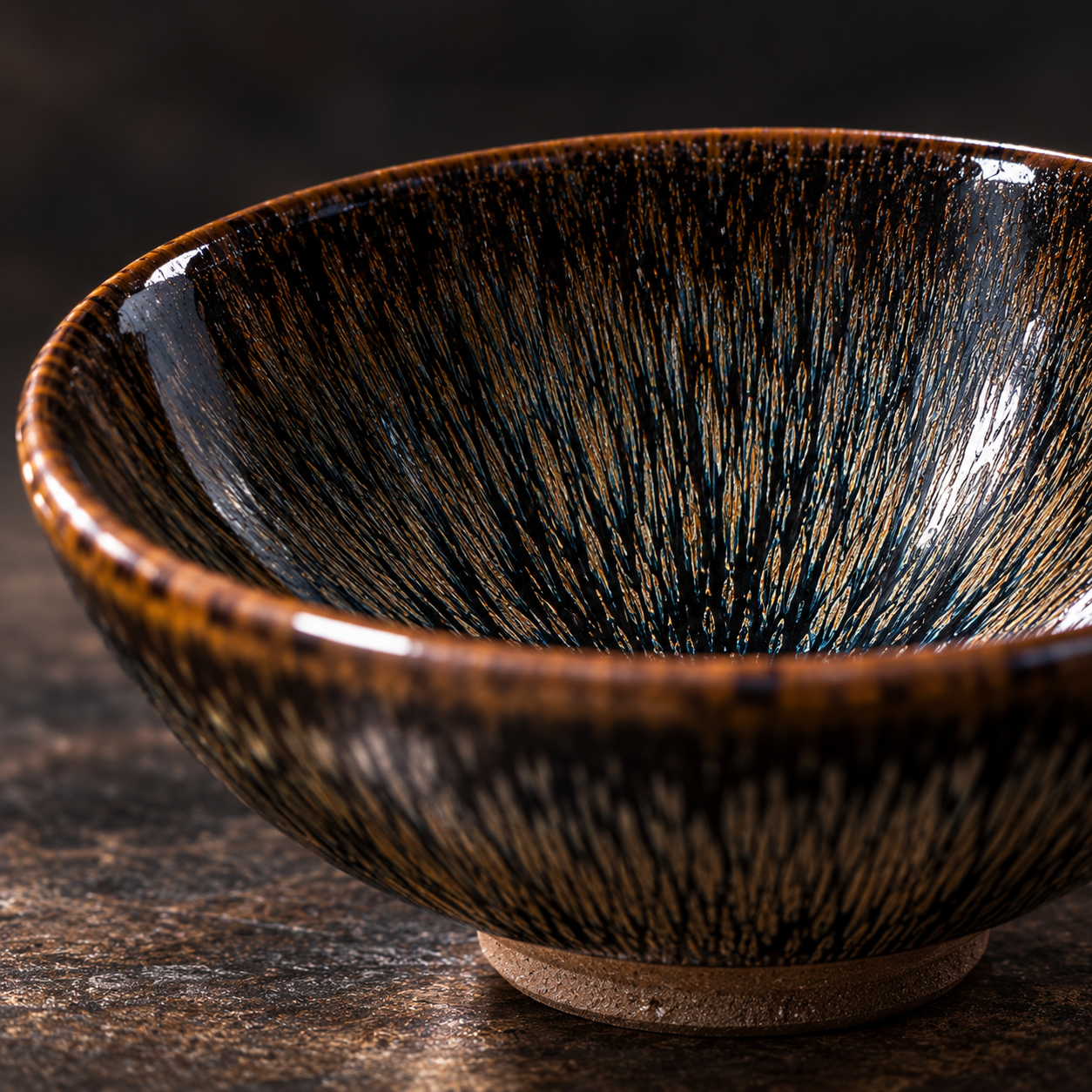
Fine streaks travel through the glaze, traditionally compared to the delicate hairs of a hare. It is one of the classic patterns associated with historical Jian ware.

Gravity and glaze movement during firing help stretch concentrations of iron into elongated lines that may appear golden, silver, brown, blue or other tones.

WHAT TO LOOK FOR

Look at the direction, fineness and continuity of the streaks. Some examples are extraordinarily delicate; others are bold and strongly defined.

Yaobian Jian Zhan glaze

RARE PHENOMENON

Yaobian

曜变

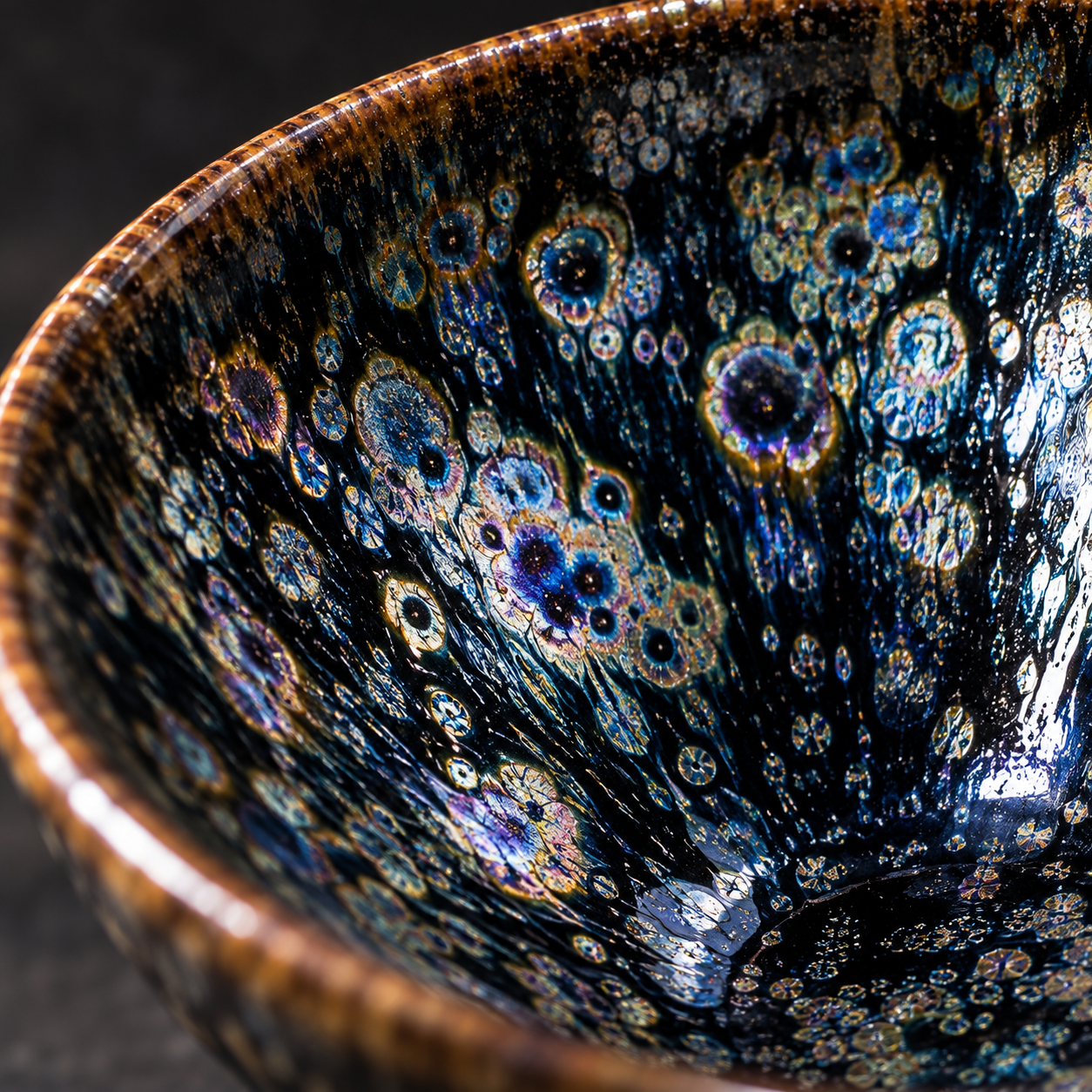
Few terms in the Jian Zhan world carry more mystique. Historic Yōhen Tenmoku bowls display luminous halos and iridescent effects surrounding crystalline spots.

Modern makers have spent years experimenting with glaze chemistry and firing techniques in pursuit of related visual effects.

WHAT TO LOOK FOR

The term Yaobian is used broadly in the contemporary marketplace. Evaluate the actual glaze rather than assuming the name makes a modern piece equivalent to historic Yōhen Tenmoku.

Wujin Jian Zhan glaze

THE BEAUTY OF BLACK

Wujin

乌金

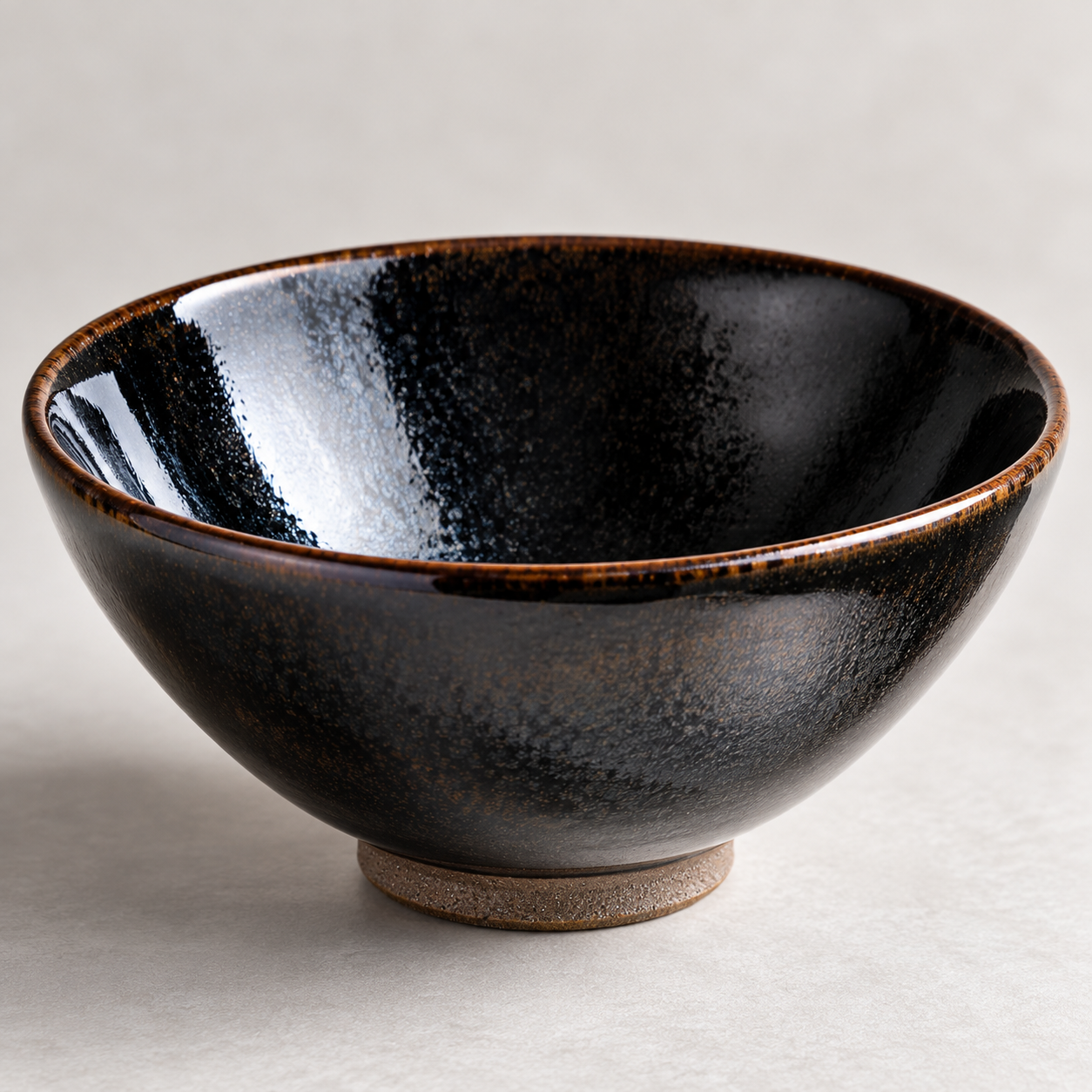
Not every exceptional Jian Zhan needs a dramatic pattern. Wujin emphasizes the richness and depth of a predominantly dark glaze.

A surface that initially appears almost uniformly black may reveal brown, metallic or mineral variation as the light and viewing angle change.

WHAT TO LOOK FOR

With no dominant crystalline pattern competing for attention, form, glaze depth, surface quality and craftsmanship become especially important.

A LIVING TRADITION

Traditional patterns.
Modern possibilities.

Historic Jian ware provides the foundation, but contemporary Jian Zhan is not limited to reproducing Song-dynasty surfaces.

Modern makers work with traditional forms and iron-rich glazes while experimenting with glaze recipes, firing schedules, kiln technologies and combinations of materials.

Collectors may encounter descriptions such as Oil Drop, Oil Spot, Hare's Fur, Partridge Feather, Wujin, Yaobian, China Red, Ox Blood, Rose Gold, Ice Crackle and many others.

COLLECTOR'S DISTINCTION

Some glaze names have strong historical or technical associations.

Others are contemporary descriptive or commercial terms.

A glaze name tells you what a maker or seller calls the effect. The piece itself tells you what is actually there.

INDIVIDUALITY

No two are exactly alike.

Even pieces from the same maker, glaze batch and firing can differ because tiny changes in glaze thickness, kiln position, temperature, atmosphere and cooling can alter the final result.

That means experienced collectors often evaluate the individual piece rather than simply choosing a maker and a glaze name.

FPO IMAGESame glaze. Different results.Three or four related bowls from one glaze family showing natural variation

LOOK CLOSER

Five things to notice in a glaze.

01

Pattern distribution

Does the effect continue naturally around the vessel? Notice where the pattern becomes concentrated, sparse or changes character.

02

Color & reflectivity

Move the piece. What happens when the viewing angle or light changes?

03

Glaze depth

Does the surface appear visually flat, or do layers, crystals and mineral effects seem to sit at different depths?

04

Flow

Follow the glaze toward the foot. Gravity and heat leave visible evidence of how the glaze moved during firing.

05

Variation

Perfect uniformity is not necessarily the goal. Natural variation can be part of what gives an individual piece its character.

THE ROLE OF FIRE

Clay and glaze provide the ingredients. Fire transforms them.

Jian Zhan requires temperatures high enough to vitrify the clay body and fully develop the glaze. The kiln atmosphere — particularly the balance of oxygen during firing — can dramatically affect how iron behaves and therefore how the glaze develops.

Historically, Jian ware was fired in large wood-burning kilns. Contemporary makers may use wood, gas or electric kilns, each offering different ways of influencing and controlling the firing.

Explore Makers & Kilns →
01WOOD

Flame, ash, atmosphere and kiln position become part of the firing environment.

02GAS

Allows makers to manipulate temperature and atmosphere with a high degree of control.

03ELECTRIC

Offers precise temperature control and another platform for contemporary glaze experimentation.

FPO IMAGEOne bowl. Different light.Same Jian Zhan photographed in soft daylight and directional light

HOW TO LOOK

Change the light. Change the bowl.

A photograph can tell you a great deal, but Jian Zhan is particularly responsive to light.

When examining a piece, try viewing it:

Soft natural light→Directional light→Several angles→Dry & filled with tea

Patterns that appear understated in one setting can become dramatically more visible in another.

This is also why a strong marketplace listing should include several photographs rather than relying on a single highly lit image.

COLLECTOR'S NOTE

Don't buy the pattern name.
Buy the piece.

Terms such as Oil Spot, Hare's Fur, Yaobian and Wujin are useful for understanding Jian Zhan, but the quality and character of an individual bowl cannot be determined by its category alone.

Look at the clay.Look at the foot.Look at the glaze transition.Look at the entire pattern.Then look again under different light.

Discovering what the kiln created is part of what makes Jian Zhan so compelling to collect.